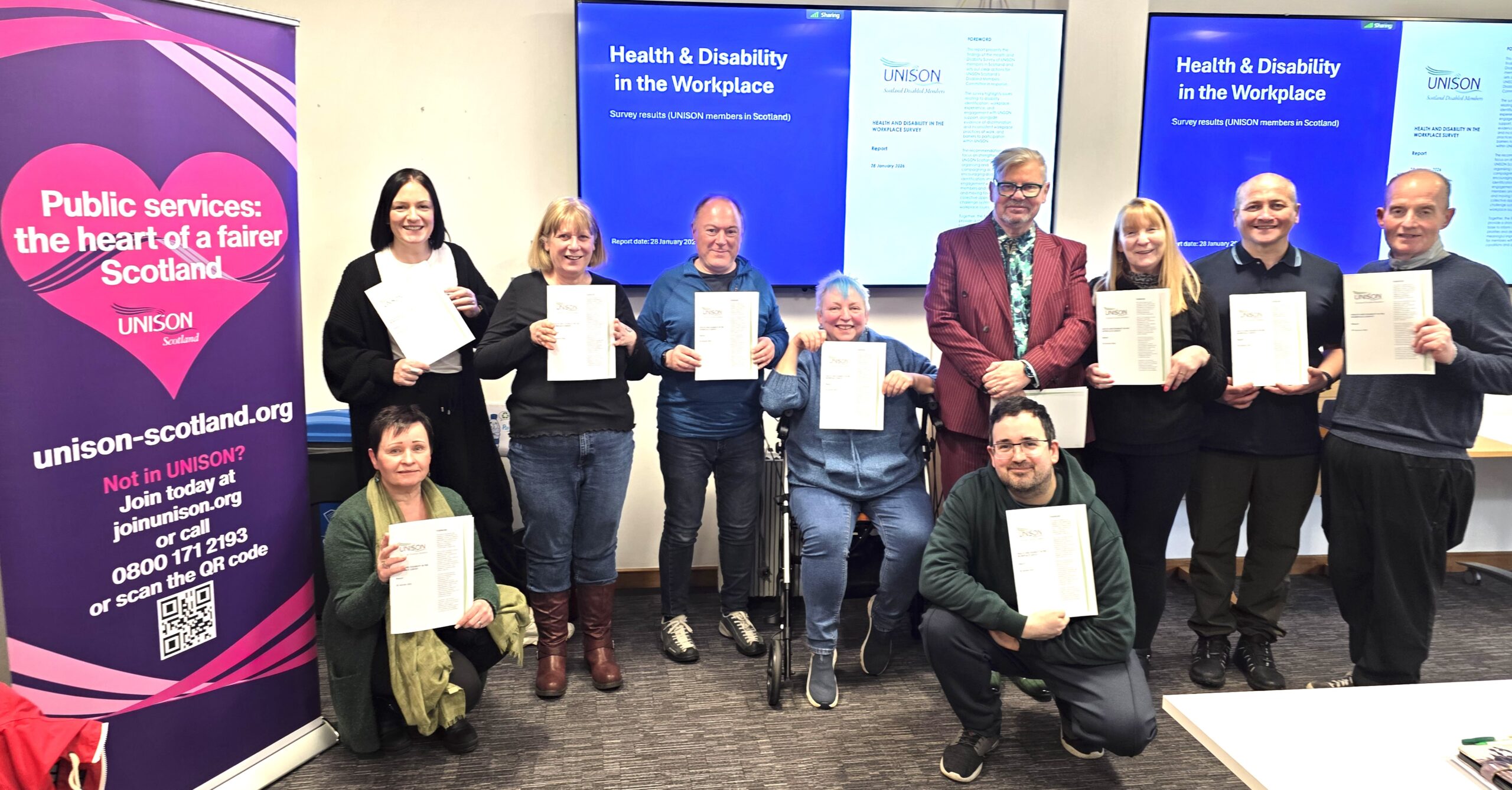
UNISON’s Disabled Members’ Committee has published the findings from its recent members’ survey, which explored the barriers disabled members face and how the committee and branches can best support activists and members.
The survey received a strong response with more than 2,000 people responding, providing invaluable insight to help shape the committee’s work. The findings highlight important themes that extend beyond the committee’s work and has wider relevance for branches across Scotland, particularly in improving accessibility, building confidence and strengthening local support structures.
The survey focused on three key areas: barriers to identifying as disabled; barriers to seeking support from branches; and to establish ways the committee can better support activists and members.
The key findings include:
1. Health and disability are core workplace issues: Health conditions and disability issues are common across our membership. The adverse impact of health problems and disabilities is an everyday reality for a large number of members and has wider workforce implications. This means conversations about health and disability belong in the same conversations as pay, staffing, and working conditions, not treated solely as an equalities issue.
2. Disclosure remains a barrier: Many members meet the definition of disabled under the Equality Act 2010, however, many would not declare this to their employer. Stigma, workplace culture and lack of confidence mean the perceived risks of disclosure often outweigh the perceived protections.
3. Expectations around reasonable adjustments are low: Most members are aware of reasonable adjustments, but many limit what they see as ‘reasonable’ to low-cost, standard adjustments. Adjustments involving changes to working patterns, remote working or redeployment were often seen as less realistic. This highlights two concerns: firstly, employers may focus on quick, low-cost fixes rather than meaningful adjustments that enable people to remain in work; and secondly, if we lower our expectations then we risk normalising the minimum rather than advocating for what is genuinely reasonable.
4. Trust and visibility: Not everyone experiencing discrimination approaches the union. Some are unsure how to reach us or lack confidence that it will make a difference. This is about trust and visibility, and it is something we can improve. There is a clear role for the committee, branches and the region in building confidence to identify, disclose and raise concerns.
5. Inclusion: Members want information and opportunities to get involved. The main barriers are work patterns, health, caring responsibilities and access to time off. Online and evening meetings were the most preferred options, which is contrary to how we typically work. Inclusion is not just about welcoming people; it is about removing practical barriers that affect who participates, who becomes active and whose voices are heard.
You can read the full survey here.